Do you notice how you take what you see every single day for granted? How you often don’t stop and really look what’s right in front of you? That is what happened to me, in Room 182 of the Skokie School where I’ve taught 6th-grade language arts and social studies every day for the last two years.
Room 182 is the first classroom on the left in the northeastern wing of Skokie School. It is unique in its appointments, including large windows with seats that face onto a grassy courtyard where a family of ducks annually nests. The windows provide the room with natural light, allowing the harsh fluorescent lights to remain off most of the time while students work. Room 182 also has a door onto the courtyard, which students find to be a welcome place to read during the warm fall and spring months.
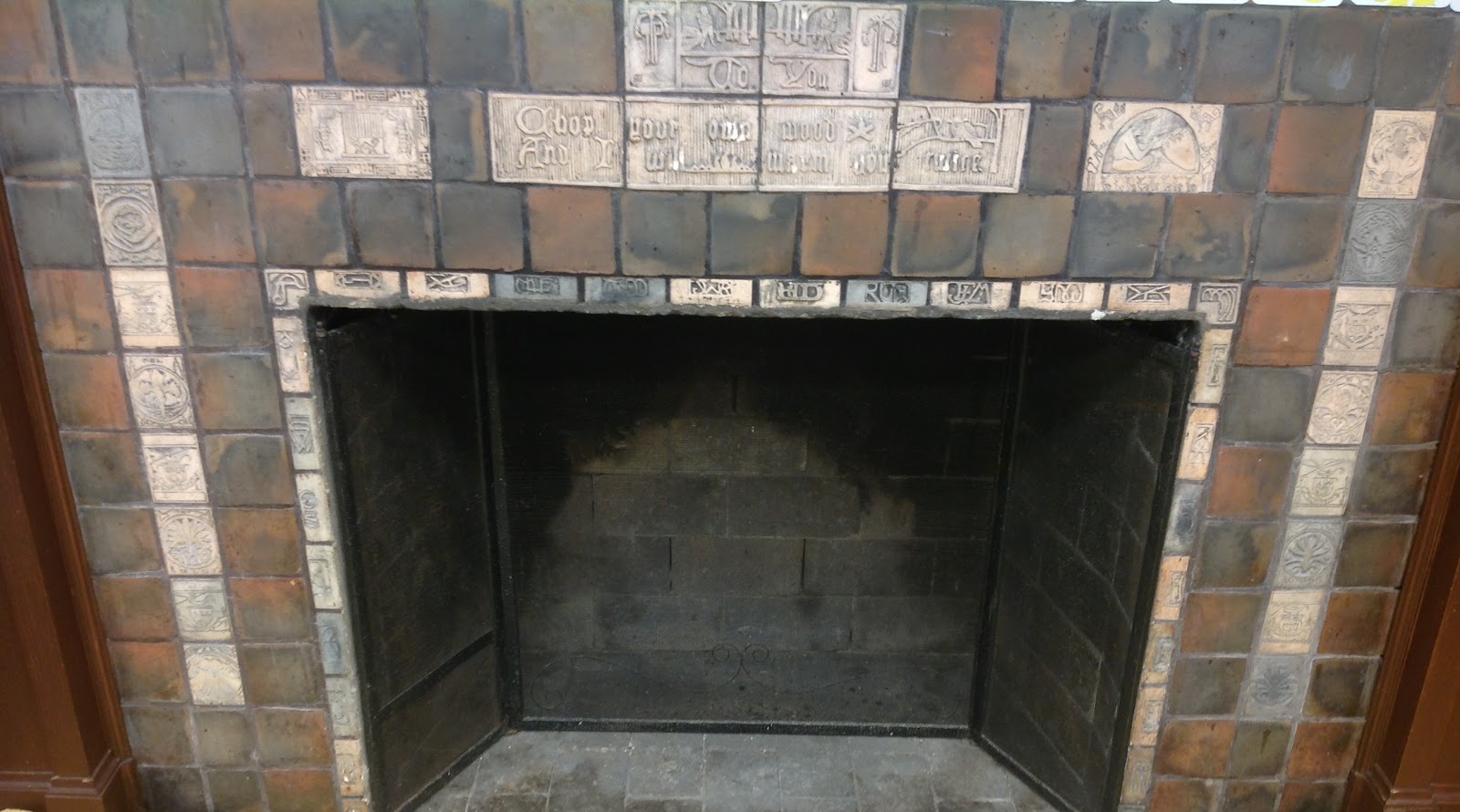
Nevertheless, the most unique feature in this room is a fireplace -- complete with mantle, hearth, and tile. It’s easy to forget about this fireplace because it seems like just another decorative feature in the classroom where kids gather for read-aloud and group discussions. But one day—after many other days-- I took a closer look and wondered, “Why a fireplace in only this classroom?” Whose idea was it? What can it tell us about education in Winnetka in the 1920s when Room 182 was conceived?” These questions took me on a voyage through the lands of California, Pennsylvania, Michigan, Egypt, and Scotland, that illuminated the philosophy of “progressive education” in the 1920s and the general treatment of women in the workplace and home.
Most of what I could find about the origins of the school was from The Skokie School - 60 Golden Years by Betty Carbol. From this pamphlet, I learned how the citizens of Winnetka raised the funds to build the school under the leadership of Laird Bell, and about the Kuppenheimer family’s donation to build its auditorium. I learned about the excitement the students had for a school that would house the sixth, seventh and eighth graders. And I learned that the “Kate Dwyer Room” was built in a later remodel that had a fireplace full of tiles. But nowhere did I see about my fireplace and my tiles.
So began my quest. I first needed to discover what was the specific purpose of Room 182. I looked to the Winnetka Talk to see if there was any information there. This is what I found in 1922 editions of The Talk:
Classroom No. [illegible] the first rom [sic] north of the assembly hall is finished as an art room. It contains a large open fireplace. There are casement windows with window seats and the whole room is made to simulate a living room. Here the girls will learn the principles of interior decoration as well as receive their regular instruction in art work. (February 1922)
And then, in a later article:
The beautifully lighted classrooms with floods of sunshine and a view over the wide expanse of playground -- bone dry -- though the Skokie was flooded [note: Skokie was built on the often flooded lagoons]... Children dragged parents to see their new rooms and especially to see, in the Art room fireplace, the tiles which the children themselves had made (4.16.1922)
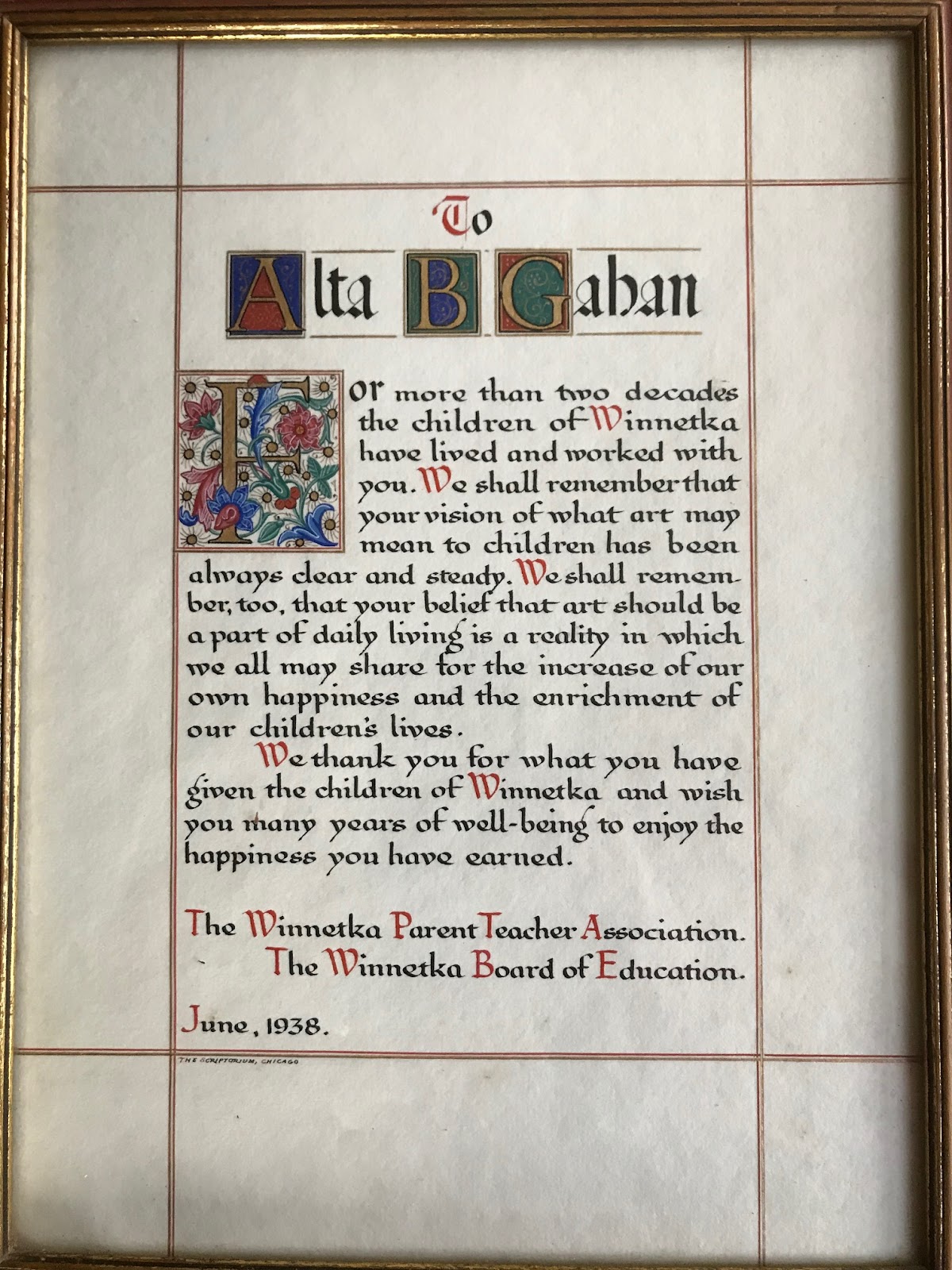
Aha! So Room 182 was originally not for basic art, but for interior design. Hence the windows and window seats for which girls (and only girls) would design and sew cushions and curtains as part of their education for when they became wives (as only men could own houses). In addition, the students themselves had made the tiles that adorned the fireplace. This took me to my next question -- whose idea was it to do this? The answer led me to the art teacher at that time, Miss Alta Gahan.
In this pre-suffragette era, female teachers were expected to be unmarried. Going against the trend, Carleton Washburne made allowances for teachers to be married. However, if a teacher had a child, she was expected to resign her position for good, and stay home to take care of her family. Despite these restrictions, teaching stood out as one of the very few careers women were allowed to pursue and, in a small way, flex their feminist muscles.
Alta Gahan was born in 1875 in Williamsport, Pennsylvania. Her father was a German immigrant and was Superintendent of the area schools. She moved to Chicago, with her brother, to attend the Art Institute, and began her teaching career in Highland Park. She began teaching in Winnetka at the Horace Mann School in 1918. She was head of the Art Department in the district and was roommates with Miss Frances Presler -- renowned for the creation of the Pioneer Room at Crow Island. Miss Gahan would stay at Skokie School until her retirement in 1938. She later moved to Pleasant Prairie Wisconsin and continued making art until her death in 1970.
Fireplace design must have been all the rage in the 1920s when Miss Gahan asked her students to create tiles for the fireplace in Room 182. The saying over the fireplace, “Chop your own wood and I will warm you twice,” is also found in the fireplace mantle of Henry Ford’s home in Detroit. Detroit is also home to Pewabic pottery and the Cranbook Academy of Art. Their influence, as well as Art Deco, can be found throughout most mission style homes built in the 20s. These modern styles obviously influenced Miss Gahan and her students. The fireplace in Room 182 echoes all three of these styles: the tile has the hues of Pewabic, while the crafted tile (especially the initials) is Art Deco. The mantle itself follows simple lines and wooden features which are dominant in Prairie Style homes.
The tiles the students created were meant to reflect the experience in Illinois as well as at Skokie School. There is an image of a Native American and multiple shields that reference the state of Illinois and ancient Greece. It appears that these tiles were etched and then fired. The rest of the tiles are initials that are designed in an art deco fashion.
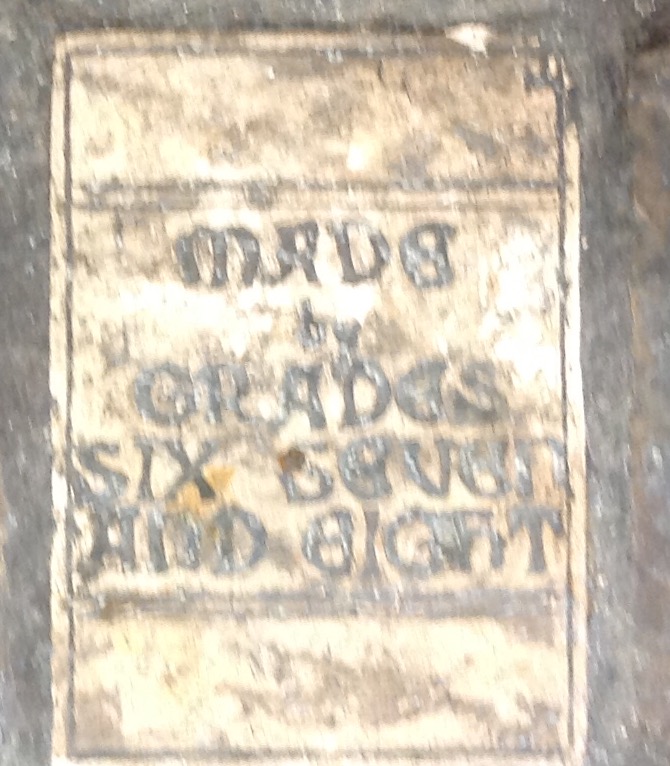
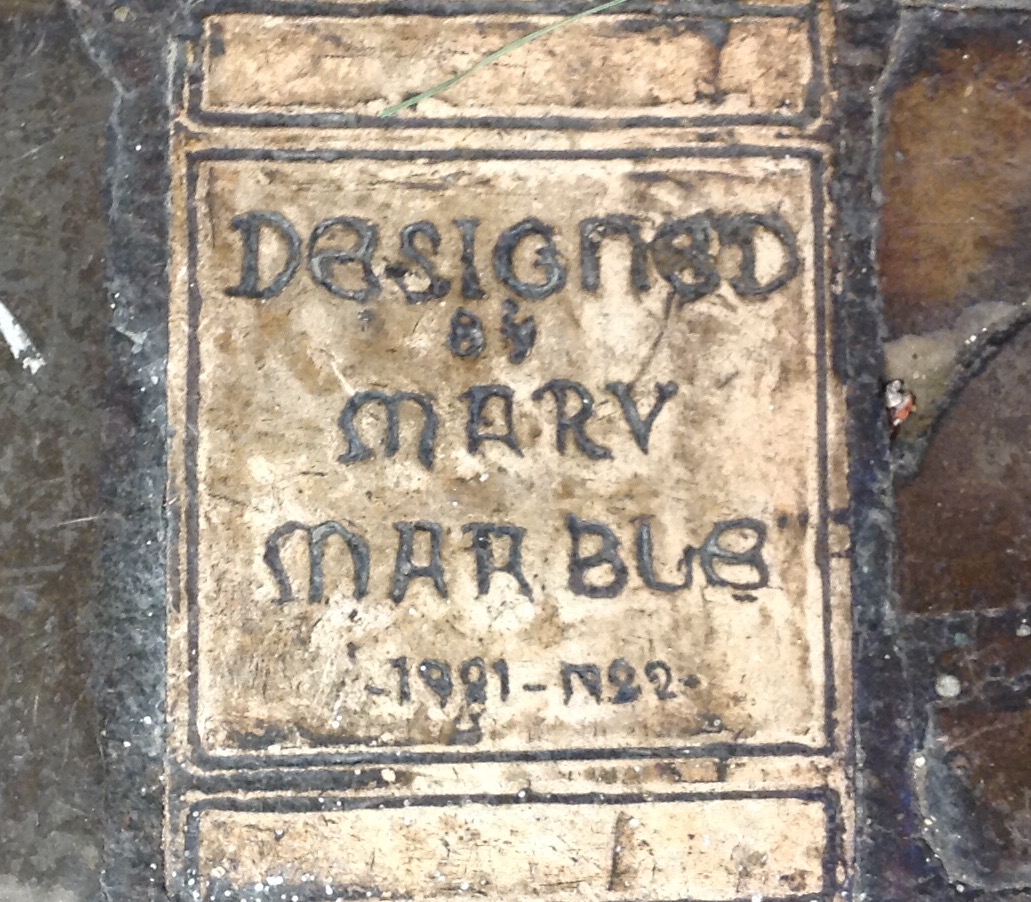
The students who created these tiles are mostly lost to history, except we know they were in grades “six, seven and eight” during the 1921-22 school year. Although my students pored through New Trier Yearbooks from 1926-1928 to infer who the creators of the tiles were, they could only guess at the actual creators. The only real clue we had was from one tile that stated: “Designed by Mary Marble 1921-1922.”
Mary Marble would have been in the 8th grade at Horace Mann School where the tiles were created. As it turns out, Mary Marble had an interesting life and her early years were a reflection on what is was to be a woman in the early decades of the 20th century. She was born in Winnetka in 1908 to Mary Eames Marble and Eugene Cleveland Marble. In 1910, she, her parents, and baby brother all lived with her paternal grandparents on Lincoln Avenue. Mary’s father worked in their family corset business downtown. In 1914, a new brother, Stuart, joined the family. By 1920, Mary’s family had moved to 848 Lincoln Avenue, just down the street from her grandparents.
It appears that Mary’s father Eugene was a little bit of a dreamer, if not selfish. He fancied himself a part of the burgeoning “aircraft industry,” but actually worked in the textile (specifically underwear) industry for most of his life. Eugene’s father Edward died in 1925. One can assume that immediately afterward in 1926, Eugene took his inheritance, uprooted his family during Mary’s senior year at New Trier, and moved to them all to Carmel, California. Once there, he divorced Mary’s mother, remarried, and lived out the rest of his life in Carmel until his death in 1975.
One wonders how Mary felt about her life and her constraints as a young woman. She obviously had talent, as Miss Gahan gave her the lead to design many, if not all the fireplace tiles. She apparently was active in the art club and yearbook at New Trier. But during her senior year in high school, she was taken across the country. Two years later, in 1928, at the age of 20, Mary Marble had married Charles Henderson and had a baby by 1930. Mary’s husband was the son of a socialite and heiress and seems to be the same kind of dreamer as Mary’s father.
I can’t find much information about her during the 1930s, but with the advent of World War II came drastic changes. Around 1940, Mary divorced her husband, and her baby brother Stuart was killed in action in 1943. The next mention I can find of Mary has her living in Cairo, Egypt and working for the OSS. In 1944, she married David Abercrombie, who was likely working as a codebreaker in Cairo. They moved to Yorkshire, England, where he established a groundbreaking career in the new subject of linguistics at the University of Leeds. Mary was by his side on each step of the journey, as is noted in his obituary in 1992:
“His successes, professional and personal, were founded above all on the resolute support of his wife, Mary. Her generosity of spirit and her warm hospitality over many years of open house on Sunday mornings lay at the heart of the friendship they both extended to all their students and colleagues, and which so enriched us all.”
With David Abercrombie, Mary found a partner who recognized her talents and with whom she found fulfillment for the rest of her long life. She passed away in 1998.
It’s hard to believe that this fireplace was the beginning of a voyage of discovery into so many people’s stories. All we had to do was notice, and remember, the little tiles that were so important to them, to make them live again.
 I love tennis. I love playing it. I love watching it. I love using the game in my classroom as a metaphor for learning and life. So yesterday, I was excited to watch newcomer Naomi Osaka take on veteran Serena Williams. They were playing for so many firsts: first Japanese finalist, first mother, first modern 24 grand slam wins. Unfortunately, the finals will be remembered for a different kind of first: the first time an umpire instituted penalty points and games in a Grand Slam final that considerably affected the outcome. As I sat in disbelief as I watched a fantastic match unravel into a spectacle I wondered, "What am I going to say to my students?" Many people might think, just ignore it, but the more I reflected, the more I saw the parallels to my classroom and wish the umpire had read and utilized Jim Fay's Love and Logic.